
Cabri G2 vs Robinson R22
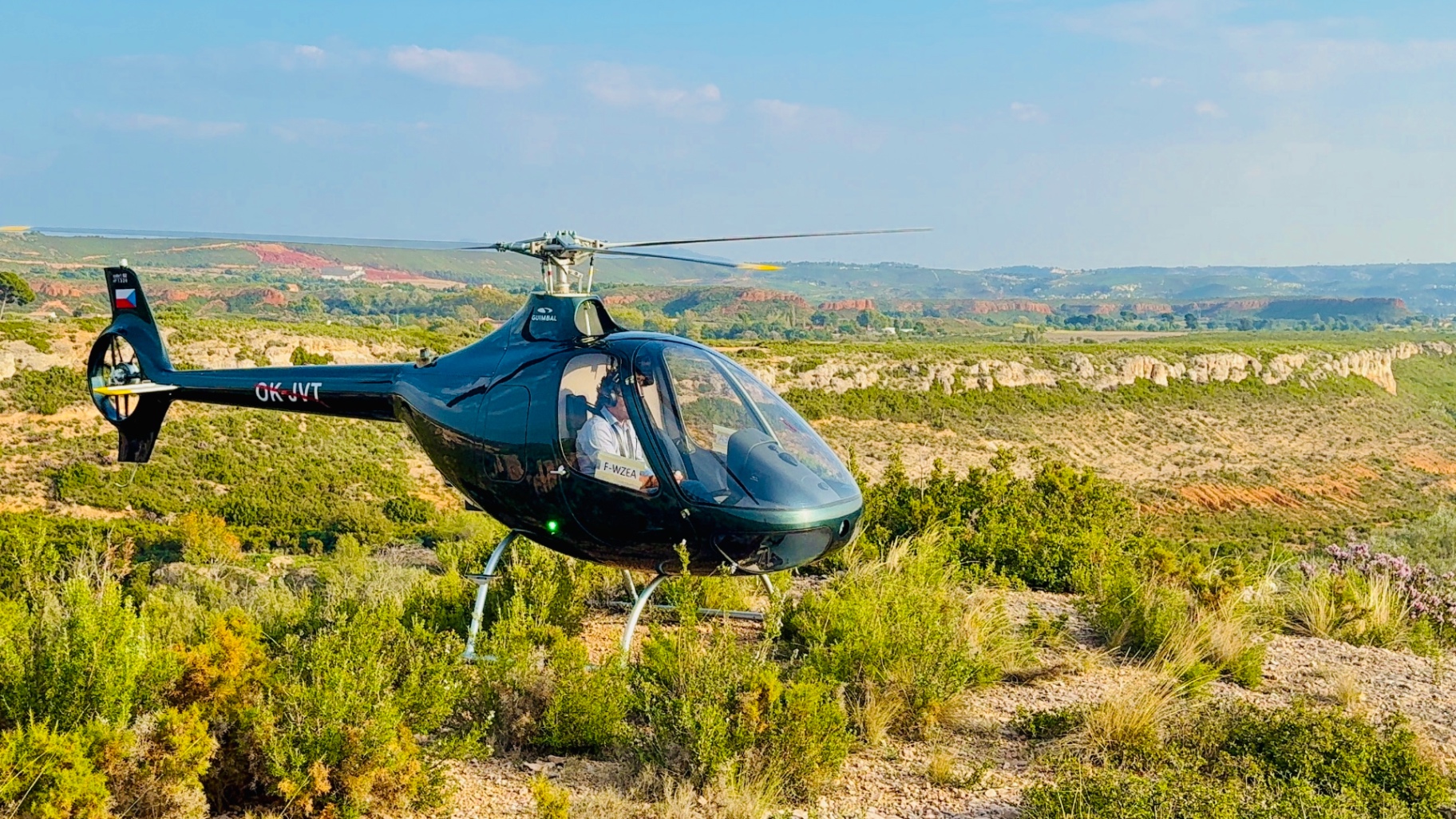
Choosing your first helicopter shapes every hour of training that follows. The Robinson R22 defined the two-seat piston trainer for four decades; the Guimbal Cabri G2 was designed from a blank sheet in the 2000s to fix its known weaknesses. Here is how they compare for a student pilot heading toward a PPL(H).
Safety by design
The R22 is a proven machine, but its handling quirks — low-G mast bumping, exposed tail rotor, marginal useful load — have driven decades of ADs and mandatory awareness training. The Cabri G2 was engineered by former Eurocopter engineer Bruno Guimbal to remove them.
Fenestron shrouded tail rotor
The enclosed tail rotor removes the single largest source of fatal ground accidents in piston trainers and cuts noise on the ramp.
No low-G mast bumping
The Cabri's fully articulated 3-blade rotor is immune to the low-G mast-bumping that has driven multiple R22 airworthiness directives.
Composite crashworthy cabin
An energy-absorbing composite structure with a crashworthy fuel system — modern certification standards the 1979 R22 was never designed to meet.
A modern cockpit
The Cabri G2 is delivered with a Garmin G500 TXi glass cockpit, GTN 750 navigator and full engine monitoring. R22 cockpits remain almost entirely analogue — great for airmanship, less useful when your next type rating is on a glass-equipped turbine.
Garmin G500 TXi glass cockpit
PFD, engine monitoring, GPS moving map and traffic on one bright display — the same avionics logic you'll fly on turbine types later.
Modern engine monitoring
Continuous EMS with exceedance recording protects the engine and simplifies the transition to CPL(H) and instrument work.
Operating cost — and how we bill it
The R22 burns roughly 8 l/h less fuel, but the Cabri G2 offsets that with a longer airframe life, a bigger useful load and lower unscheduled maintenance from a modern composite structure. Where it really pays off for students is how the hour is counted.
Per-minute billing at LionHeli
We charge Cabri G2 flight time by the minute, not by rounded 6-minute or 15-minute blocks. A 47-minute lesson costs you 47 minutes — not a rounded-up hour. Over a full PPL(H) course that difference alone often covers several extra training hours.
Fewer surprises
12-year vs 15-year airframe overhauls, exposed tail-rotor damage and R22-specific AD compliance all push R22 hourly rates up. The Cabri's newer certification basis keeps total cost of ownership predictable across a 200-hour PPL/CPL syllabus.
Which one should you learn on?
If you can only find an R22, it will absolutely take you to a licence — thousands of pilots have done it. But if the Cabri G2 is available to you, it is the safer, more modern and more forward-compatible trainer. At LionHeli we operate the largest Cabri G2 fleet in the Czech Republic and bill it by the minute, so you get more airtime for the same budget.
Robinson and R22 are trademarks of Robinson Helicopter Company. This page is an independent comparison and is not affiliated with or endorsed by Robinson.